Last Updated: Oct 21, 2026
Uploaded By: NotesLover
984 Views
Physics Light Refraction Optics Science Notes Snell's Law
Refraction of Light: Definition, Laws, and Real-Life Examples
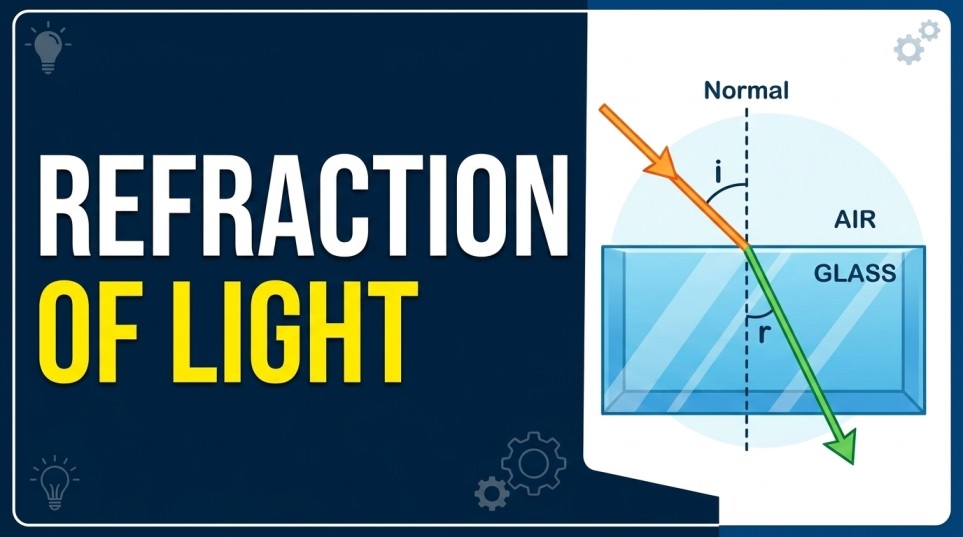
Have you ever noticed how a straw in a glass of water looks broken or bent at the surface? Or why a swimming pool always looks shallower than it actually is? These are not magic tricks or illusions of the mind; they are perfect examples of a fundamental physics phenomenon known as the Refraction of Light. For students and science enthusiasts, understanding refraction is the key to unlocking how lenses, cameras, and even our own eyes work to perceive the world.
In this detailed guide by Noteslover, we will break down the complex science of light bending into simple, easy-to-digest concepts. We will explore why light changes direction, the laws that govern this behavior, and how we use this science in our daily technology.
Definition of Refraction
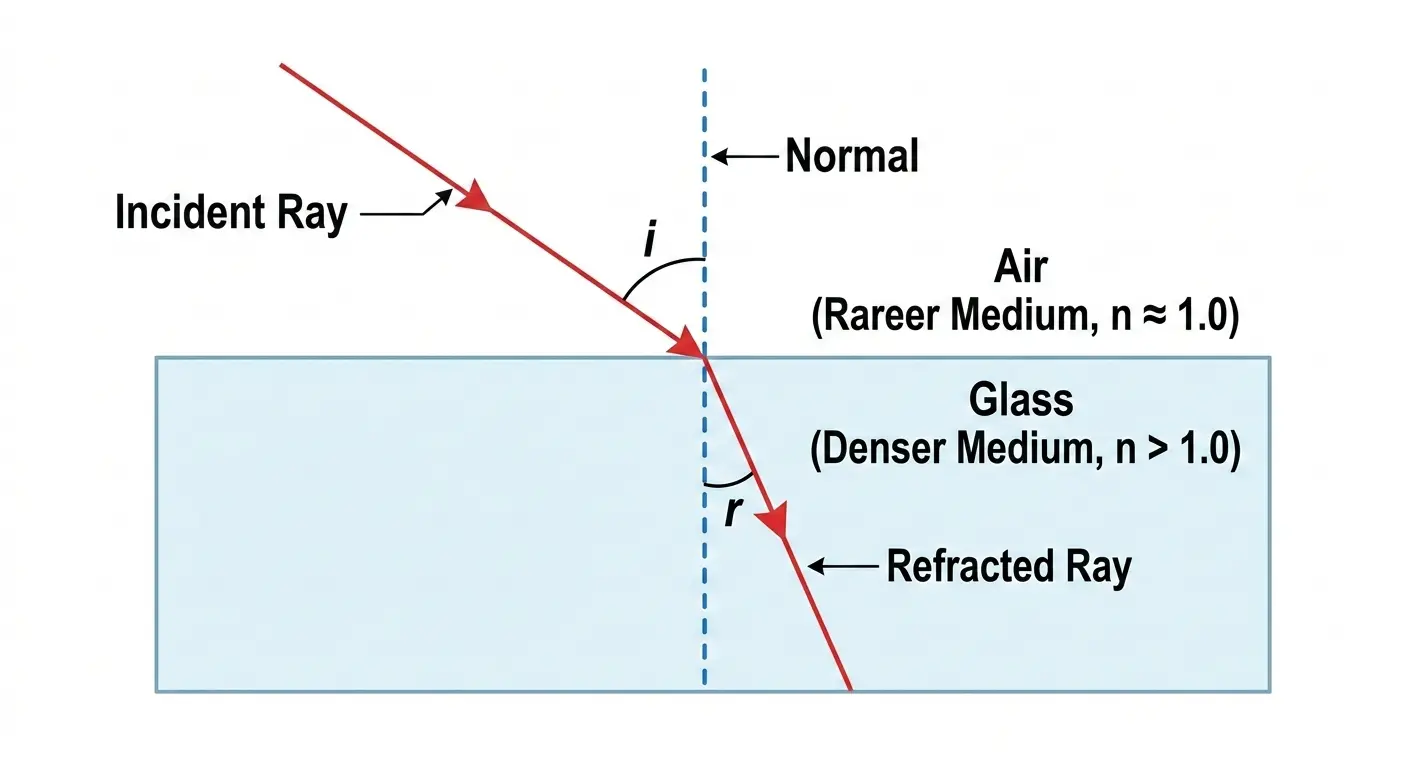
In the simplest terms, refraction is the bending of light as it passes from one transparent substance (medium) into another. This bending occurs because light travels at different speeds in different materials. For instance, light moves incredibly fast in a vacuum or air, but it slows down significantly when it enters denser materials like water, glass, or diamond.
When light hits the boundary of two different media at an angle, one side of the light wave slows down before the other, causing the entire beam to pivot or "bend." This is very similar to how a lawnmower pivots when it moves at an angle from a paved sidewalk onto thick grass—one wheel slows down first, causing the mower to turn.
Structure and Components of Refraction
To understand refraction diagrams and solve physics problems, you must be familiar with the specific components involved in the process. Scientists use a standard set of terms to describe the path of light.
1. The Incident Ray
The ray of light that approaches and strikes the boundary between two media is called the incident ray. This is the "incoming" light before any bending has occurred.
2. The Refracted Ray
Once the light enters the second medium and changes its direction, it is known as the refracted ray. The path of this ray depends on whether the second medium is more or less "optically dense" than the first.
3. The Normal
The normal is an imaginary line drawn perpendicular (at a 90-degree angle) to the surface where the light hits the boundary. We use the normal as a reference point to measure angles.
4. Angle of Incidence (i)
This is the angle formed between the incident ray and the normal. It is usually denoted by the letter $i$.
5. Angle of Refraction (r)
This is the angle formed between the refracted ray and the normal. It is denoted by the letter $r$.
6. Optical Density
This refers to how much a material slows down light. It is different from physical density. For example, oil is physically less dense than water (it floats), but it is often more optically dense (light travels slower in it).
Laws of Refraction
Refraction is not random; it follows two strict mathematical laws that allow us to predict exactly how much light will bend.
The First Law
The incident ray, the refracted ray, and the normal at the point of incidence all lie in the same plane. This means if you drew them on a flat piece of paper, they would all stay flat on that paper.
The Second Law (Snell’s Law)
This is the most famous part of refraction science. Snell’s Law states that the ratio of the sine of the angle of incidence to the sine of the angle of refraction is a constant for a given pair of media. This constant is called the Refractive Index ($\mu$ or $n$).
The mathematical formula is written as:
$$\frac{\sin i}{\sin r} = n$$
The refractive index ($n$) can also be calculated by comparing the speed of light in a vacuum ($c$) to the speed of light in the medium ($v$):
$$n = \frac{c}{v}$$
Uses and Applications
Without refraction, many of the tools we use today would not exist. Here is how we harness the power of bending light:
- Corrective Lenses: Eyeglasses and contact lenses use refraction to redirect light so it focuses correctly on the retina of your eye, fixing nearsightedness or farsightedness.
- Cameras: Camera lenses refract light to converge it onto a sensor, creating a sharp image of the world.
- Microscopes: These devices use multiple refracting lenses to magnify tiny objects like bacteria or plant cells.
- Telescopes: Refracting telescopes use large lenses to gather and bend light from distant stars and planets, making them appear closer.
- Fiber Optics: Although they use "total internal reflection," the basic principle involves controlling how light refracts and reflects inside glass cables to transmit high-speed internet data.
- Binoculars: Prisms inside binoculars refract light to flip images and shorten the physical length of the device.
Advantages of Refraction
The ability to control the path of light provides several advantages in science and daily life:
| Advantage | Explanation |
|---|---|
| Vision Enhancement | Refraction allows us to create lenses that correct human vision, improving quality of life for billions. |
| Magnification | By bending light, we can see objects that are too small or too far away for the naked eye to perceive. |
| Data Transmission | Refraction principles allow light to carry information through fiber optic cables much faster than electrical wires. |
| Medical Imaging | Lenses in endoscopes allow doctors to look inside the human body without performing invasive surgery. |
Comparison: Refraction vs. Reflection
Students often confuse these two terms. While both involve light interacting with a surface, they are very different processes.
| Feature | Reflection | Refraction |
|---|---|---|
| Action | Light "bounces" off a surface. | Light "passes through" and bends. |
| Medium | Light stays in the same medium. | Light moves from one medium to another. |
| Surface | Happens on shiny, opaque surfaces (like mirrors). | Happens on transparent surfaces (like glass/water). |
| Law | Angle of Incidence = Angle of Reflection. | Follows Snell's Law ($\frac{\sin i}{\sin r} = n$). |
Real-Life Examples of Refraction
You can see refraction in action almost anywhere. Here are the most common examples to help you visualize the concept:
1. The "Broken" Pencil
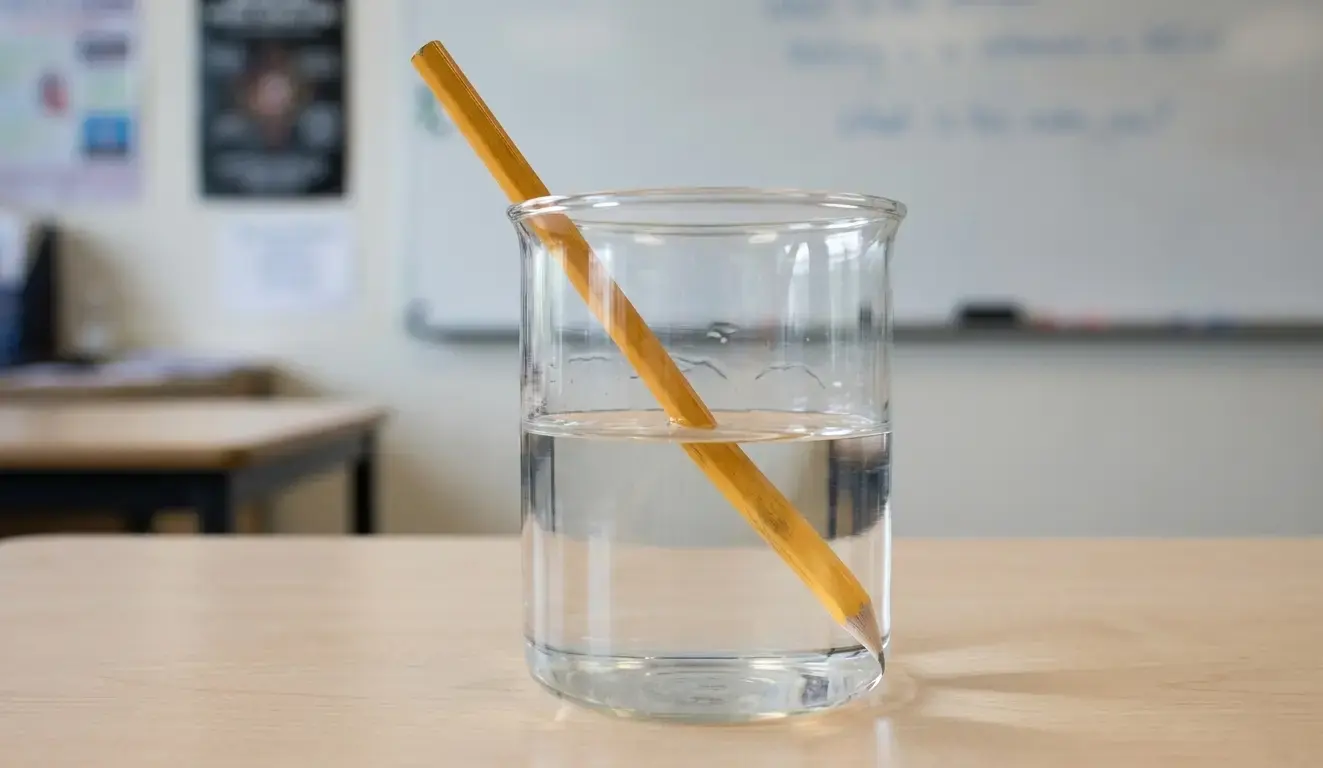
When you place a pencil in a half-filled glass of water, the pencil appears shifted or broken at the water's surface. This is because light rays from the part of the pencil underwater bend as they exit the water and enter the air, changing how your eye perceives the position of the pencil.
2. Formation of a Rainbow
A rainbow is a beautiful display of refraction. Sunlight enters a raindrop, slows down, and bends (refracts). It then reflects off the back of the drop and refracts again as it leaves. During this process, the light is split into its component colors: Red, Orange, Yellow, Green, Blue, Indigo, and Violet.
3. Twinkling Stars
Stars twinkle because of atmospheric refraction. As starlight travels through the Earth's atmosphere, it passes through layers of air with different temperatures and densities. This causes the light to bend constantly, making the star appear to shift slightly in position and brightness.
4. Mirages on Hot Roads
On a very hot day, you might see what looks like a puddle of water on the road ahead. This is a mirage. It happens because the air near the road is much hotter than the air above it. Light from the sky refracts through these different air layers, bending back up toward your eyes and creating an image of the sky on the ground.
Frequently Asked Questions
What is the Refractive Index?
The refractive index is a number that describes how much light bends when entering a material. A higher number means the light slows down more and bends more sharply. For example, water has a refractive index of 1.33, while diamond has a refractive index of 2.42.
Why does light change speed in different media?
Light is an electromagnetic wave. When it enters a medium like glass, it interacts with the atoms and electrons in that material. These interactions slow down the progress of the wave through the substance.
What happens if light goes from a denser medium to a rarer medium?
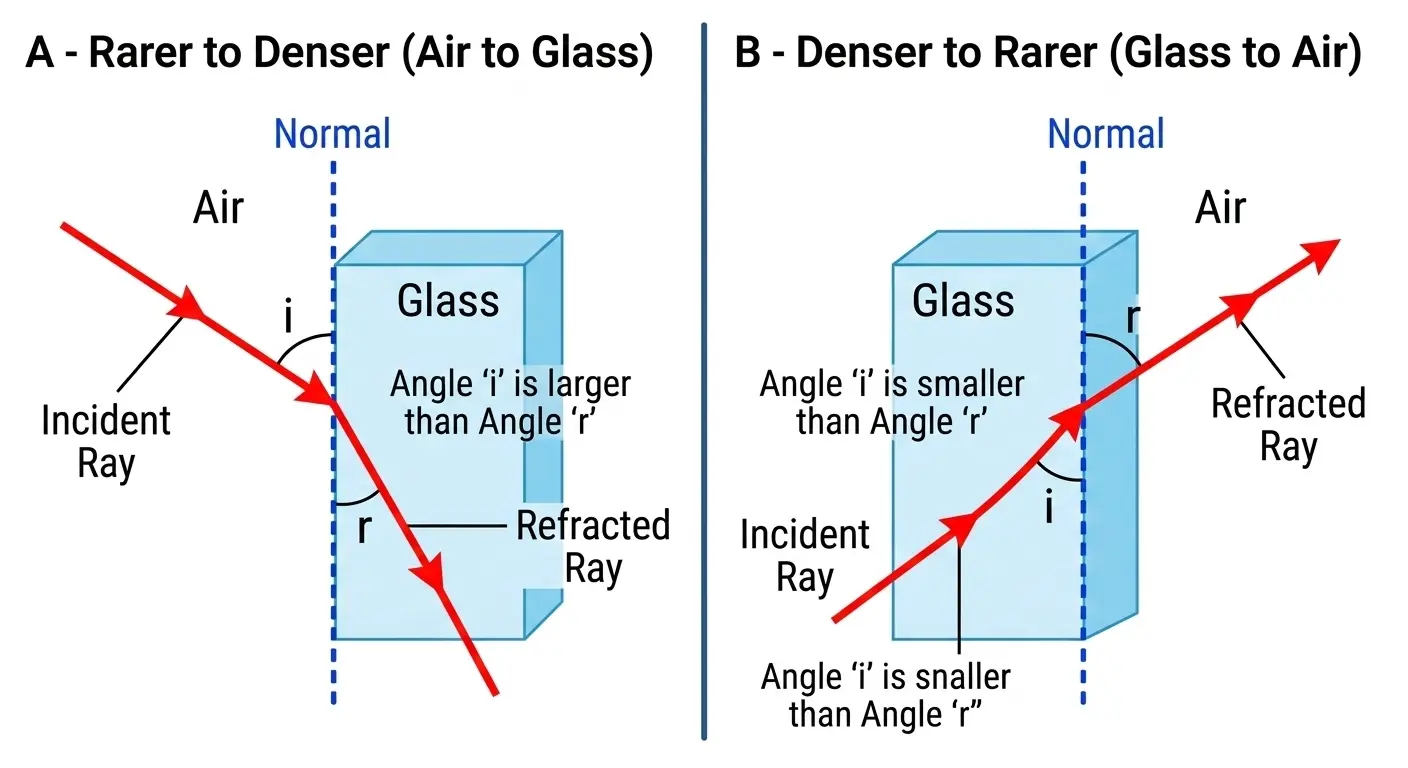
When light moves from a denser medium (like water) to a rarer medium (like air), it speeds up and bends away from the normal. This is the opposite of what happens when light enters a denser medium.
What is Total Internal Reflection?
If light is traveling from a denser medium to a rarer medium and hits the boundary at a very large angle (the critical angle), it won't refract at all. Instead, it reflects entirely back into the denser medium. This is the principle behind fiber optic cables.
Conclusion
Refraction of light is more than just a chapter in a physics textbook; it is a vital part of how we interact with our environment. From the glasses on our faces to the high-speed data that powers our internet, the bending of light makes modern life possible. By mastering the concepts of optical density, the normal, and Snell's Law, you can understand the mechanics behind some of nature's most beautiful sights, like rainbows and twinkling stars.
We hope this guide helped clarify your doubts about refraction! For more educational resources, check out our other articles on [Placeholder: Internal Link to Reflection of Light] and [Placeholder: Internal Link to Spherical Lenses]. Keep exploring and stay curious!
Would you like me to create a practice quiz on Refraction to help you prepare for your exams?
Recent Blogs
- Top 200 One Word Substitution (OWS) for SSC CGL, CHSL, CPO, MTS & Other Exams
- Top 200 Antonyms for SSC CGL, CHSL, CPO, MTS & Other Competitive Exams
- Top 200 Synonyms for SSC CGL, CHSL, CPO, MTS & Other Competitive Exams
- Top 200 Idioms for SSC CGL, SSC CHSL, SSC CPO, MTS, and Others with Meanings, Examples & PYQ Practice
- English Grammar Basics: Learn Rules & Sentence Structure
Recent Previous Year Papers
Recent Success Story
- SSC CGL Success Story: Rahul Parik AIR 13 - Complete Journey
- सिद्धार्थ गुप्ता UPPCS सक्सेस स्टोरी – संघर्ष, रणनीति और सफलता की पूरी कहानी
- Shubham Agrawal - SSC CGL Topper Success Story
- UPSC 2025 Top 3 Toppers - Strategy, Preparation & Study Guide
- Shakti Dubey - UPSC CSE 2024 Topper: Journey, Strategies, and Success Secrets

NotesLover
Learn. Download. Grow.
NotesLover HQ, Moradabad, Uttar Pradesh 244001, India
Quick Links
Top Categories
Subscribe
© 2026 Notes Lover. All rights reserved.