Last Updated: Oct 20, 2026
Uploaded By: NotesLover
816 Views
Physics Kinematics Science Notes Speed Velocity Scalar Vector Education Motion Mechanics Noteslover Exam Preparation Physics Formulas Class 9 Physics Class 11 Physics
Difference Between Speed and Velocity: The Ultimate Guide for Students
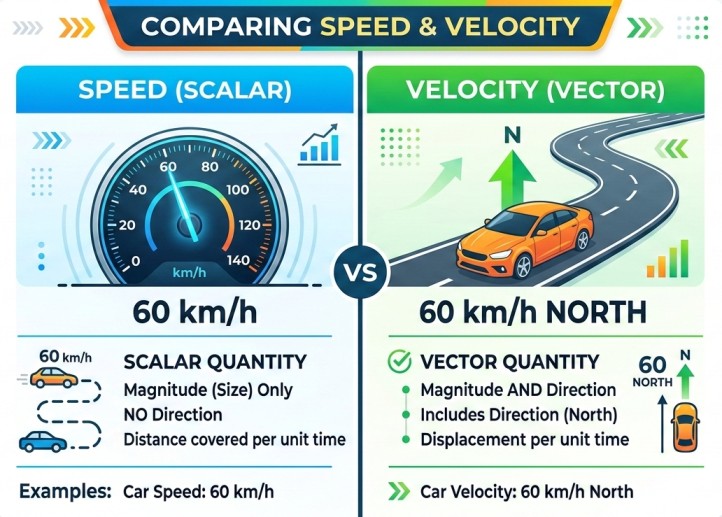
In physics, we often use words like "fast" or "slow" to describe how things move. However, when we want to be scientific, we use two specific terms: Speed and Velocity. While many people use these words to mean the same thing in daily conversation, they have very different meanings in the world of science.
If you are a student preparing for exams or simply curious about how the universe works, understanding the difference between speed and velocity is a fundamental step. This article on Noteslover will break down these concepts using simple language, clear examples, and easy-to-read tables to help you master the topic.
Definition of Speed and Velocity
To understand the difference, we first need to define each term individually. Both relate to how fast an object is moving, but one includes a specific "extra" piece of information.
What is Speed?
Speed is defined as the rate at which an object covers distance. It tells us how fast an object is moving regardless of its direction. For example, if a car travels 60 kilometers in one hour, its speed is 60 km/h. It doesn't matter if the car is going North, South, or driving in circles; as long as it is moving, it has speed.
What is Velocity?
Velocity is defined as the rate at which an object changes its position in a specific direction. In simpler terms, velocity is "speed with a direction." If that same car travels 60 km/h toward the North, we are now talking about its velocity. If the car changes direction but keeps the same speed, its velocity has changed because the direction is different.
Structure and Components
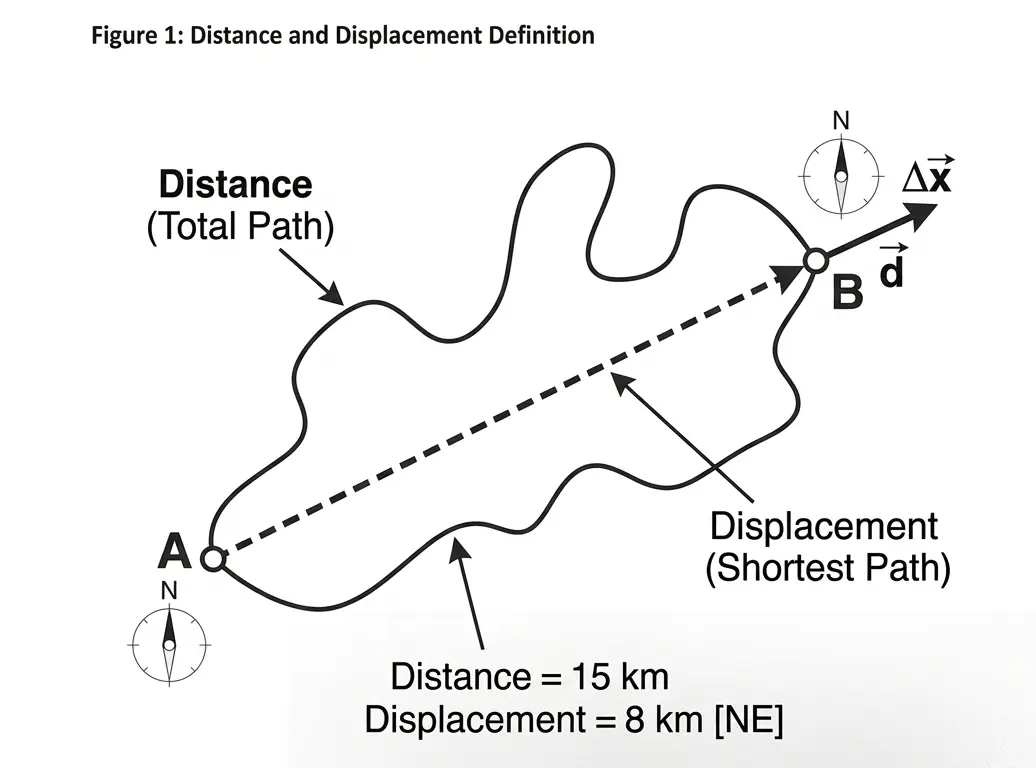
Both speed and velocity are calculated using distance, displacement, and time. However, the components used for each formula are slightly different.
1. The Components of Speed
The formula for speed involves two main components:
- Distance: The total path length traveled by an object.
- Time: The duration taken to cover that distance.
The mathematical formula is:
$$Speed = \frac{Total Distance}{Time Taken}$$
2. The Components of Velocity
The formula for velocity involves displacement instead of total distance:
- Displacement: The shortest straight-line distance between the starting point and the ending point, including the direction.
- Time: The duration taken for the change in position.
The mathematical formula is:
$$Velocity = \frac{Displacement}{Time Taken}$$
Uses and Applications
Why do we need two different words for movement? It turns out that knowing the direction is vital in many real-world scenarios.
Applications of Speed
Speed is used when the direction of travel isn't the most important factor. Common uses include:
- Road Safety: Speed limits on highways are set to ensure cars don't travel too fast for the road conditions.
- Athletics: In a 100-meter dash, coaches measure how fast a runner covers the track to determine their speed.
- Internet: We measure "download speed" to see how much data moves per second.
Applications of Velocity
Velocity is crucial when the destination and direction are as important as the speed. Common uses include:
- Aviation: Pilots must know their velocity to ensure they reach the correct airport. A plane flying at 500 km/h East will end up in a different country than one flying 500 km/h West.
- Weather Forecasting: Meteorologists track the velocity of storms and hurricanes to predict which cities need to evacuate.
- Space Exploration: To put a satellite into orbit, scientists must calculate the exact velocity required to break Earth's gravity in a specific direction.
Comparison Table: Speed vs. Velocity
This table provides a quick summary of the major differences between the two concepts for quick revision.
| Feature | Speed | Velocity |
|---|---|---|
| Type of Quantity | Scalar (Magnitude only) | Vector (Magnitude + Direction) |
| Formula | Distance / Time | Displacement / Time |
| Direction | Does not depend on direction | Changes if direction changes |
| Value | Can never be negative or zero (if moving) | Can be negative, positive, or zero |
| SI Unit | Meters per second (m/s) | Meters per second (m/s) |
Advantages of Using Velocity Over Speed
While speed is easier to calculate, velocity provides a more complete picture of an object's motion. Here are the advantages of using velocity in scientific studies:
| Advantage | Explanation |
|---|---|
| Precision | Velocity tells you exactly where an object is heading, which prevents confusion in navigation. |
| Calculation of Acceleration | Acceleration is the rate of change of velocity. You cannot accurately calculate how an object speeds up or slows down without knowing velocity. |
| Predictability | Using velocity allows scientists to predict the future position of a moving object (like a planet or a missile) with high accuracy. |
Real-Life Examples
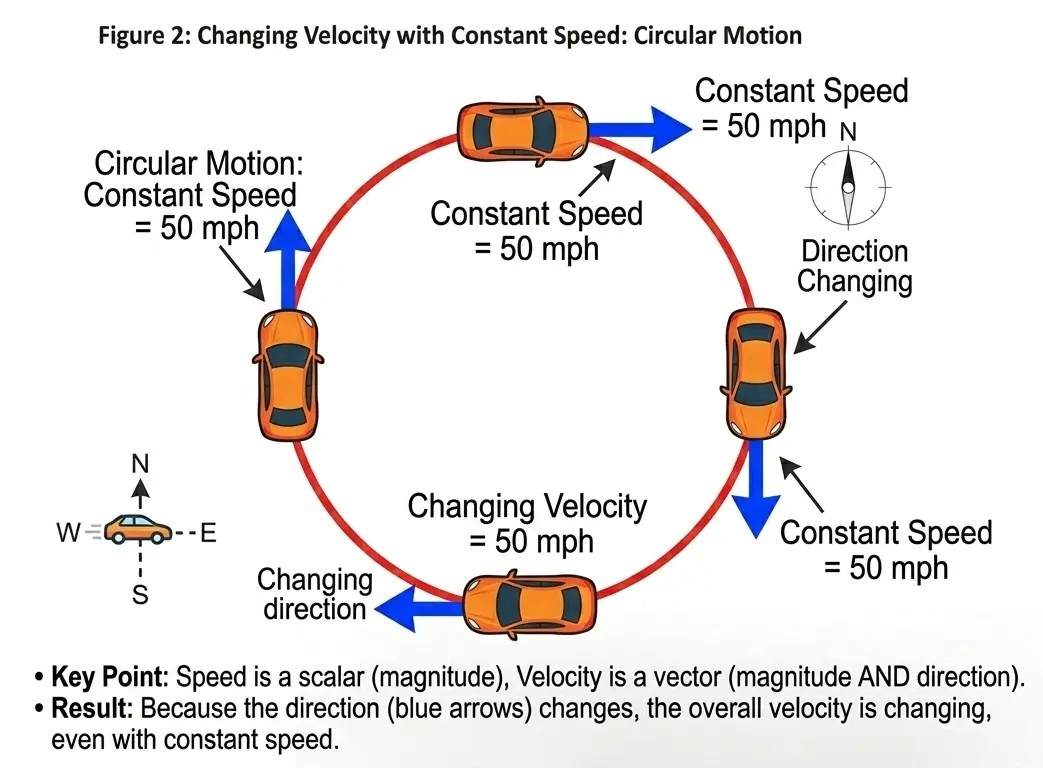
To make these concepts stick, let’s look at some practical examples you might encounter in your daily life or in a physics lab.
Example 1: The Circular Track
Imagine an athlete running around a circular track that is 400 meters long. If the athlete runs one full lap in 50 seconds and ends up exactly where they started:
- Speed: The athlete covered 400 meters in 50 seconds. The speed is $400 / 50 = 8 \text{ m/s}$.
- Velocity: Since the athlete started and ended at the same spot, the total displacement is 0. Therefore, the average velocity for the entire lap is $0 / 50 = 0 \text{ m/s}$.
Example 2: The Driving Car
If you are driving at 50 mph and you turn a corner while keeping the needle on "50," your speed remains constant. However, because you are changing your direction, your velocity is changing. In physics, a change in velocity is called acceleration!
Frequently Asked Questions
Can velocity be zero if speed is not zero?
Yes. If you travel from your house to the store and back to your house, your total displacement is zero. This means your average velocity is zero, even though you were moving at a certain speed the whole time.
What is the SI unit for both speed and velocity?
The International System of Units (SI) for both speed and velocity is meters per second (m/s). Other common units include kilometers per hour (km/h) and miles per hour (mph).
Is speed always equal to the magnitude of velocity?
Only if the object travels in a straight line without changing direction. If the path is curved, the distance will be greater than the displacement, making speed higher than the magnitude of average velocity.
Why is velocity considered a vector?
Velocity is a vector because it is not fully described until you mention the direction. Saying "the wind is blowing at 20 mph" is speed. Saying "the wind is blowing at 20 mph from the West" is velocity.
Conclusion
In summary, while speed and velocity both describe how fast something is moving, the addition of direction makes velocity a much more powerful tool for scientists, engineers, and pilots. Speed tells you how fast you are going; velocity tells you how fast and where you are going.
Understanding this distinction is key to mastering kinematics and higher-level physics. For more helpful physics guides and study notes, keep exploring Noteslover! (Internal link: Check out our guide on Newton's Laws of Motion here).
Final Takeaway: Remember that Speed = Scalar and Velocity = Vector. If you change your direction, you change your velocity, even if you don't slow down!
Recent Blogs
- Top 200 One Word Substitution (OWS) for SSC CGL, CHSL, CPO, MTS & Other Exams
- Top 200 Antonyms for SSC CGL, CHSL, CPO, MTS & Other Competitive Exams
- Top 200 Synonyms for SSC CGL, CHSL, CPO, MTS & Other Competitive Exams
- Top 200 Idioms for SSC CGL, SSC CHSL, SSC CPO, MTS, and Others with Meanings, Examples & PYQ Practice
- English Grammar Basics: Learn Rules & Sentence Structure
Recent Previous Year Papers
Recent Success Story
- SSC CGL Success Story: Rahul Parik AIR 13 - Complete Journey
- सिद्धार्थ गुप्ता UPPCS सक्सेस स्टोरी – संघर्ष, रणनीति और सफलता की पूरी कहानी
- Shubham Agrawal - SSC CGL Topper Success Story
- UPSC 2025 Top 3 Toppers - Strategy, Preparation & Study Guide
- Shakti Dubey - UPSC CSE 2024 Topper: Journey, Strategies, and Success Secrets

NotesLover
Learn. Download. Grow.
NotesLover HQ, Moradabad, Uttar Pradesh 244001, India
Quick Links
Top Categories
Subscribe
© 2026 Notes Lover. All rights reserved.