Last Updated: Sep 13, 2026
Uploaded By: NotesLover
723 Views
Physics Newton's Laws Dynamics Force and Motion Class 9 Physics Class 11 Physics Mechanics
Newton's Second Law of Motion: Formula, Derivation, and Real-Life Examples
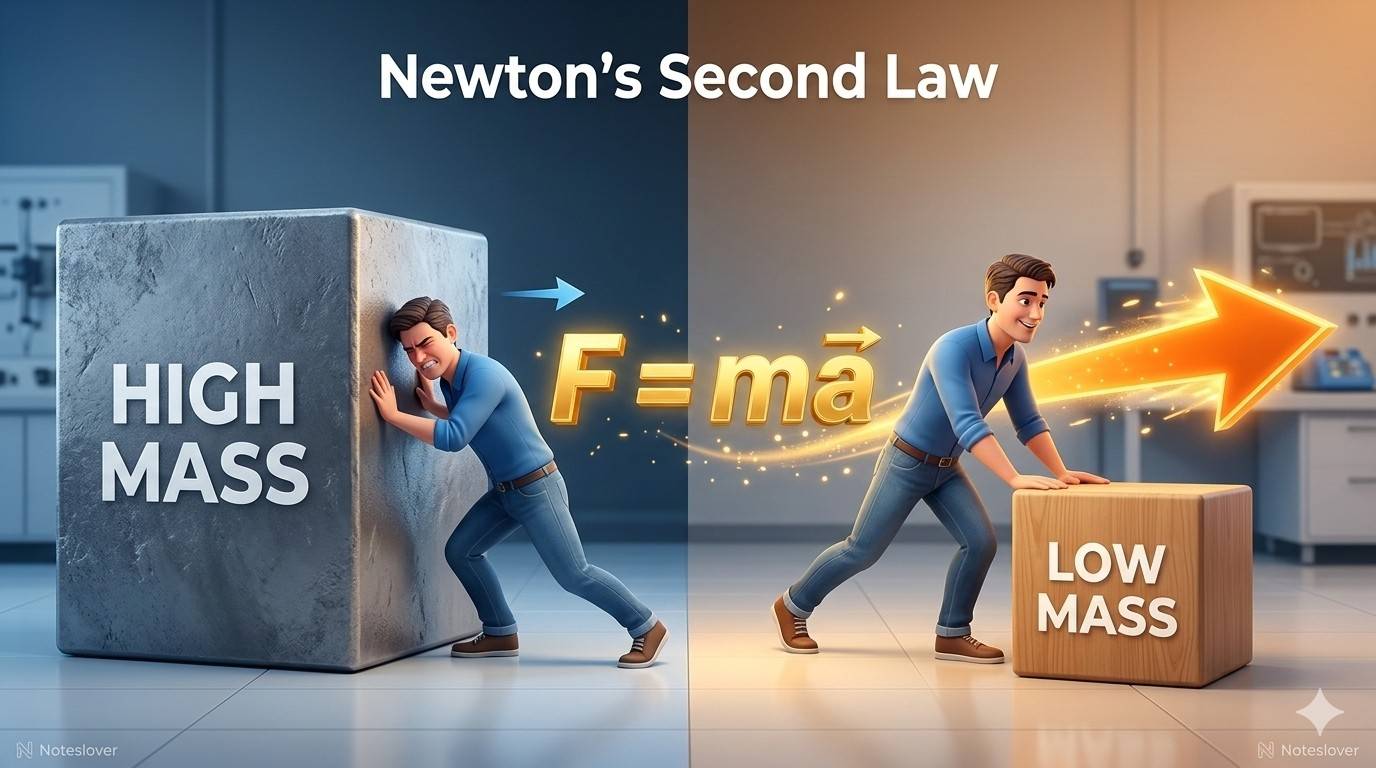
Welcome to Noteslover! If you have ever wondered why it is harder to push a heavy truck than a small toy car, you are already thinking about physics. While Newton's First Law tells us what happens when forces are balanced, Newton's Second Law of Motion gives us the exact math to calculate what happens when forces are unbalanced. It is the bridge between how much "stuff" an object has (mass) and how fast it changes its speed (acceleration).
In this guide, we will break down the formula $F = ma$, look at how to derive it for your school exams, and explore examples that you see every day-from sports to car safety. This article is designed to help students master the concept clearly and effectively.
Definition of Newton's Second Law
Newton's Second Law of Motion states that the acceleration of an object depends on two variables: the net force acting upon the object and the mass of the object.
In formal terms: The rate of change of momentum of an object is directly proportional to the applied unbalanced force in the direction of the force.
Structure and Components of the Law
The beauty of the Second Law is its mathematical structure. It is expressed by the most famous equation in classical mechanics:
$$F = m \cdot a$$
1. Force ($F$)
Force is the "push" or "pull" applied to the object. In the Second Law, we specifically look at the Net Force. If two people are pushing a box in opposite directions, you subtract the smaller force from the larger one to find the Net Force. It is measured in Newtons (N).
2. Mass ($m$)
Mass is the amount of matter in an object. It represents the object's resistance to change (inertia). The heavier an object is, the more mass it has. It is measured in Kilograms (kg).
3. Acceleration ($a$)
Acceleration is the rate at which the velocity of an object changes over time. If an object speeds up, slows down, or changes direction, it is accelerating. It is measured in meters per second squared ($m/s^2$).
From the formula $F = ma$, we can also derive the formula for acceleration:
$$a = \frac{F}{m}$$
Uses and Applications
Newton's Second Law is used in almost every field of engineering and science. Here are some key areas where it is applied:
- Rocket Science: Engineers calculate the exact amount of thrust (force) needed to lift a specific mass of a rocket to reach escape velocity.
- Automotive Safety: Car manufacturers use the law to design "crumple zones." By increasing the time it takes for a car to stop during a crash, they reduce the acceleration, which lowers the force exerted on the passengers.
- Sports: Whether it's a cricket player swinging a bat or a football player kicking a ball, they are using force to accelerate a mass.
- Elevator Design: Engineers calculate the tension in elevator cables based on the mass of the cabin and the desired acceleration to ensure passenger comfort and safety.
Advantages of Using Newton's Second Law
Why is this law so important for students and scientists? Here is a breakdown of its advantages:
| Feature | Explanation / Benefit |
|---|---|
| Quantifiability | It turns a "feeling" of a push into a precise number that can be measured. |
| Predictability | If you know the force and mass, you can predict exactly where an object will be in the future. |
| Versatility | It applies to everything from microscopic particles to giant planets. |
| Foundation of Physics | It allows us to understand more complex topics like Work, Energy, and Power. |
Comparison: Relationship Between Force, Mass, and Acceleration
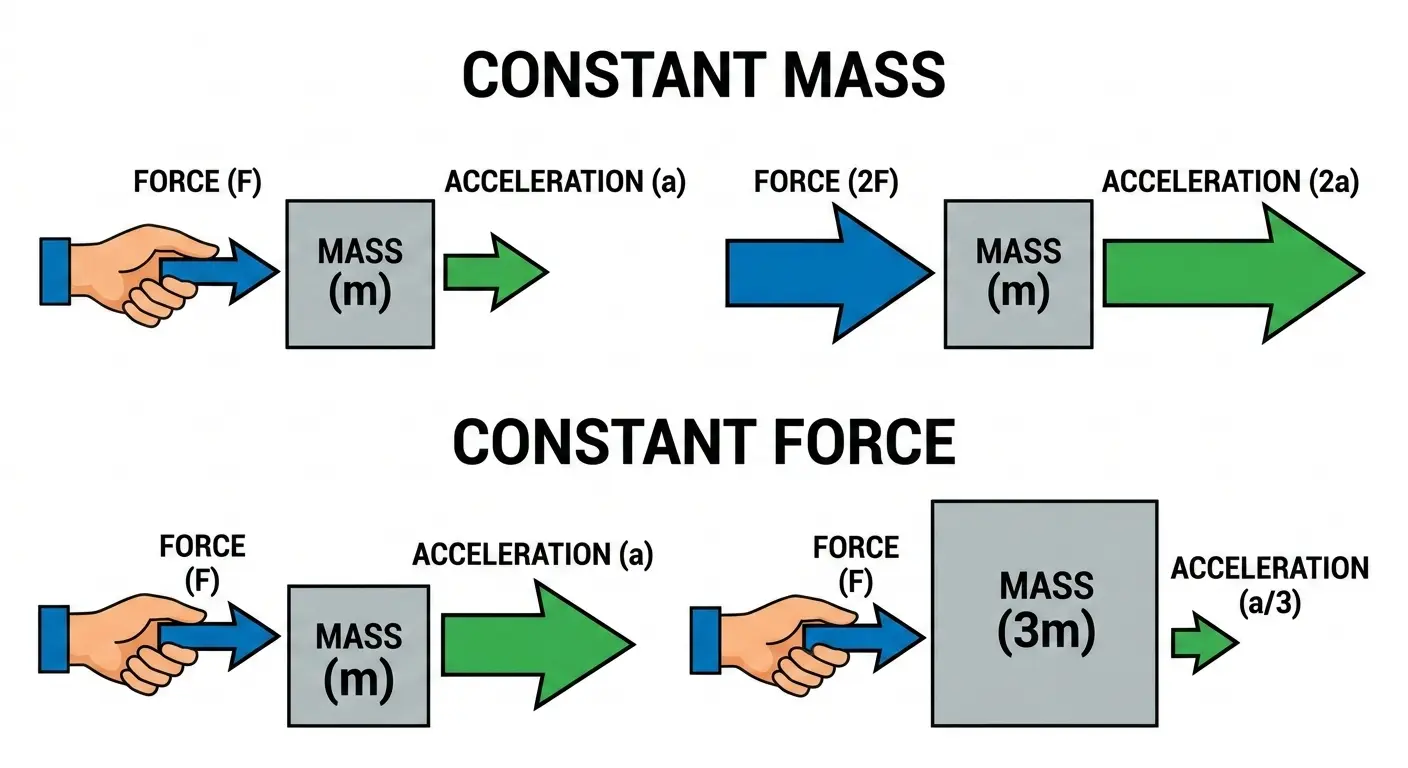
To understand the law better, look at how these three variables interact with each other in this comparison table:
| Scenario | Variable Kept Constant | Resulting Observation |
|---|---|---|
| Double the Force | Mass ($m$) | The acceleration doubles ($2a$). |
| Double the Mass | Force ($F$) | The acceleration is cut in half ($\frac{1}{2}a$). |
| Triple the Force and Triple the Mass | None | The acceleration remains the same ($a$). |
Real-Life Examples
Let's look at how Newton's Second Law works in the real world with these everyday examples:
1. Pushing a Shopping Cart
When you push an empty shopping cart, it accelerates very quickly with a small push. However, once the cart is full of groceries (increased mass), you have to push much harder (increased force) to get it to move at the same speed. This is a direct demonstration of $F = ma$.
2. Kicking a Ball
If you kick a football and a bowling ball with the same amount of force, the football will fly across the field while the bowling ball will barely move. Because the bowling ball has a much higher mass, its acceleration is much lower for the same force.
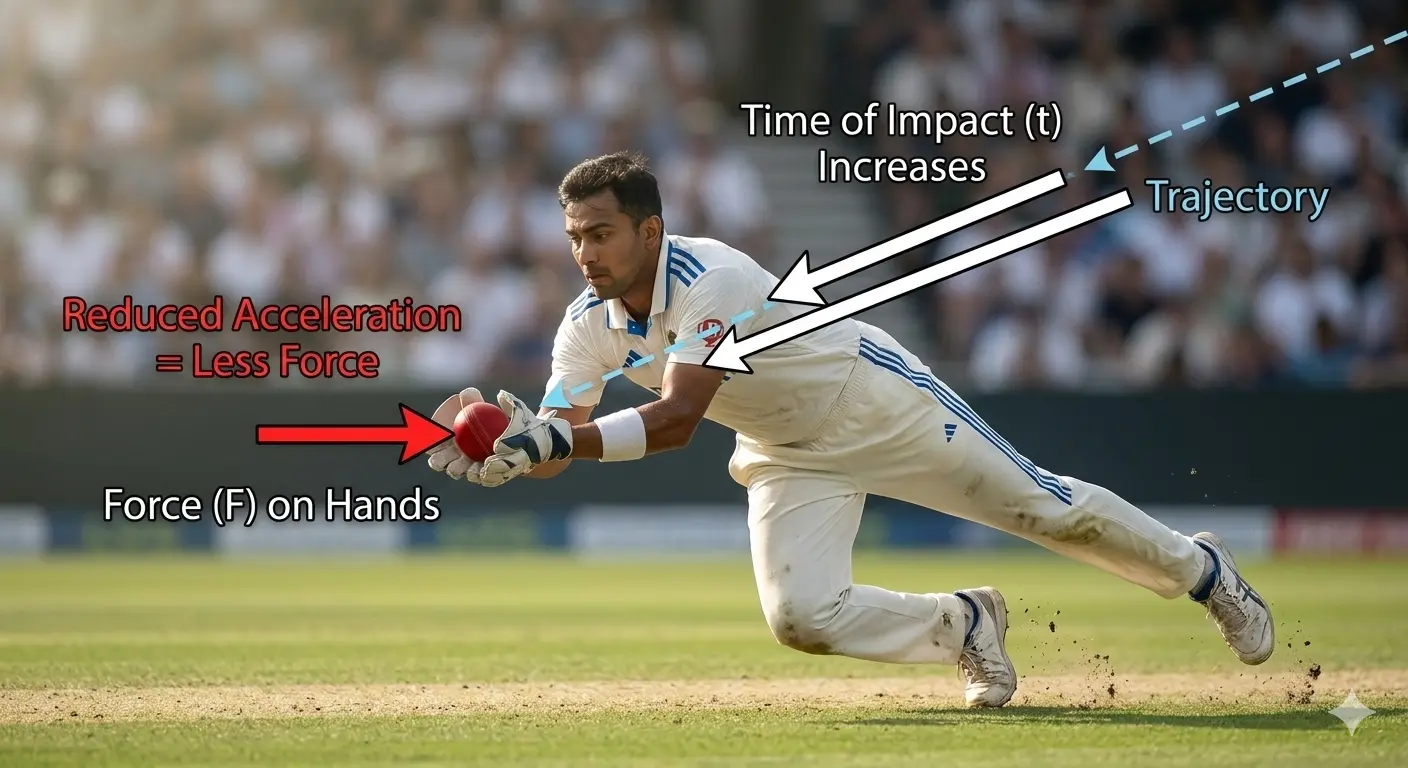
3. Catching a Cricket Ball
A cricket player pulls their hands back while catching a fast-moving ball. By doing this, they increase the time it takes for the ball's velocity to reach zero. This decreases the acceleration (deceleration), which reduces the force hitting their hands, preventing injury.
Frequently Asked Questions (FAQs)
1. What is the SI unit of Force?
The SI unit of force is the Newton (N). One Newton is defined as the amount of force required to give a 1 kg mass an acceleration of $1 m/s^2$.
2. How is the Second Law different from the First Law?
The First Law (Inertia) describes what happens when there is no net force (objects stay as they are). The Second Law describes what happens when there is a net force (objects accelerate).
3. Is the Second Law a vector or scalar quantity?
Force and Acceleration are vector quantities, meaning they have both magnitude and direction. Mass is a scalar quantity. The direction of acceleration is always the same as the direction of the net force.
4. What happens if the mass becomes zero?
In the world of classical physics, mass cannot be zero for physical objects. If it were, any tiny force would result in infinite acceleration, which is not possible in our daily reality.
Conclusion
Newton's Second Law of Motion is the heart of dynamics. It tells us that motion is not just magic-it is a calculated result of force and mass. By mastering the formula $F = ma$, you gain the power to calculate the movements of everything around you. Whether you are aiming for a career in engineering or just trying to pass your next physics test, remember: Force and acceleration are best friends, and mass is the one that tries to slow them down!
For more easy-to-understand physics notes, check out our other guides on Newton's First Law and Newton's Third Law.
Recent Blogs
- Top 200 One Word Substitution (OWS) for SSC CGL, CHSL, CPO, MTS & Other Exams
- Top 200 Antonyms for SSC CGL, CHSL, CPO, MTS & Other Competitive Exams
- Top 200 Synonyms for SSC CGL, CHSL, CPO, MTS & Other Competitive Exams
- Top 200 Idioms for SSC CGL, SSC CHSL, SSC CPO, MTS, and Others with Meanings, Examples & PYQ Practice
- English Grammar Basics: Learn Rules & Sentence Structure
Recent Previous Year Papers
Recent Success Story
- SSC CGL Success Story: Rahul Parik AIR 13 - Complete Journey
- सिद्धार्थ गुप्ता UPPCS सक्सेस स्टोरी – संघर्ष, रणनीति और सफलता की पूरी कहानी
- Shubham Agrawal - SSC CGL Topper Success Story
- UPSC 2025 Top 3 Toppers - Strategy, Preparation & Study Guide
- Shakti Dubey - UPSC CSE 2024 Topper: Journey, Strategies, and Success Secrets

NotesLover
Learn. Download. Grow.
NotesLover HQ, Moradabad, Uttar Pradesh 244001, India
Quick Links
Top Categories
Subscribe
© 2026 Notes Lover. All rights reserved.