Last Updated: Sep 15, 2026
Uploaded By: NotesLover
520 Views
Physics Newton's Laws Motion Inertia Education Noteslover Science Explained Classical Mechanics Physics Examples Study Material
Newton's First Law of Motion: The Law of Inertia Explained
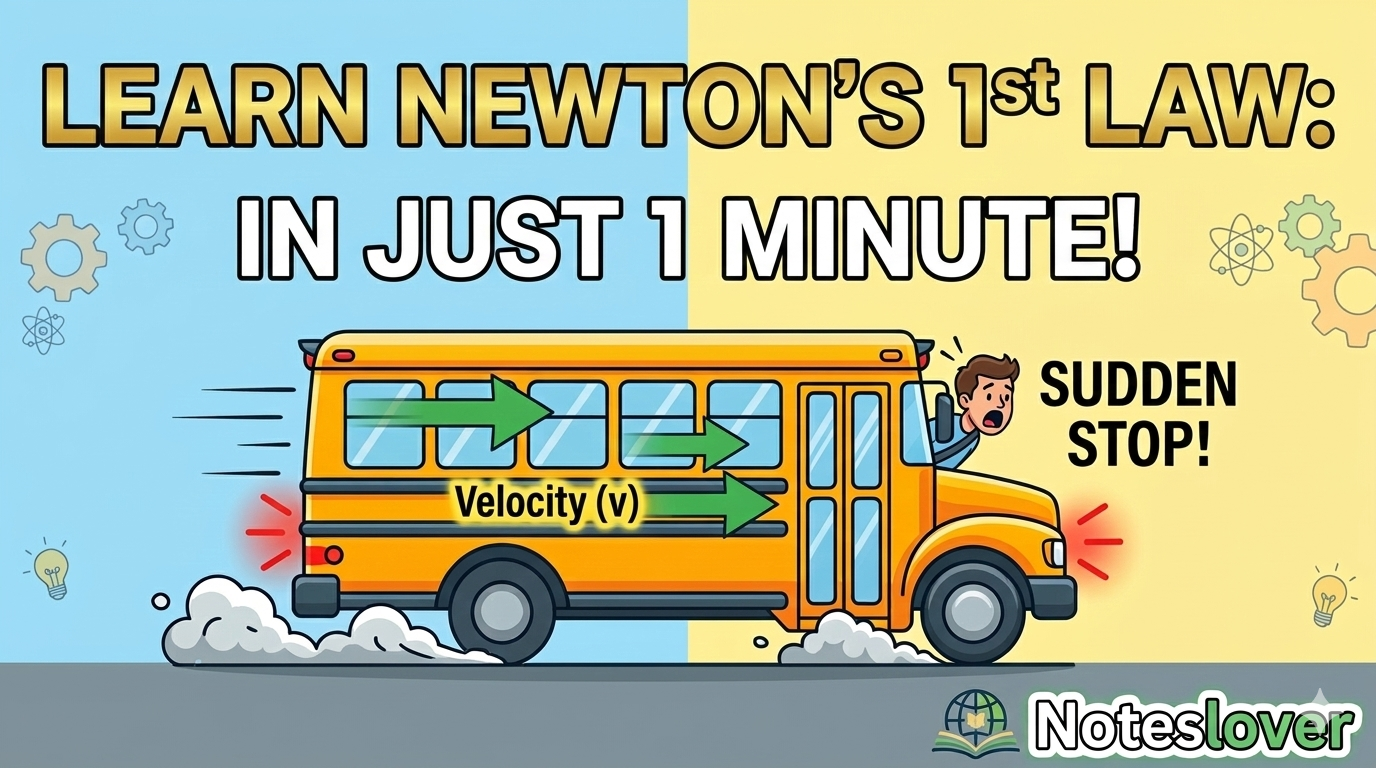
Welcome to Noteslover, your ultimate destination for simplified physics notes. Today, we are diving deep into one of the most fundamental principles of science: Newton’s First Law of Motion. Whether you are a high school student preparing for exams or a curious learner, understanding this law is the first step toward mastering classical mechanics.
Sir Isaac Newton changed the way we look at the world when he published his work in 1687. His first law describes how objects behave when forces are—or are not—acting upon them. It challenges our everyday intuition and explains why you feel a jerk when a bus suddenly starts or stops. Let’s explore this fascinating concept in detail.
Definition of Newton’s First Law
Newton’s First Law of Motion states that an object will remain at rest, or continue to move at a constant velocity in a straight line, unless acted upon by a deficient external force. In simpler terms, objects are "lazy"—they want to keep doing exactly what they are already doing.
This law is often called the Law of Inertia. Inertia is the inherent property of an object to resist any change in its state of motion. If an object is sitting still, it wants to stay still. If it is moving, it wants to keep moving at the same speed and in the same direction.
Components of the First Law
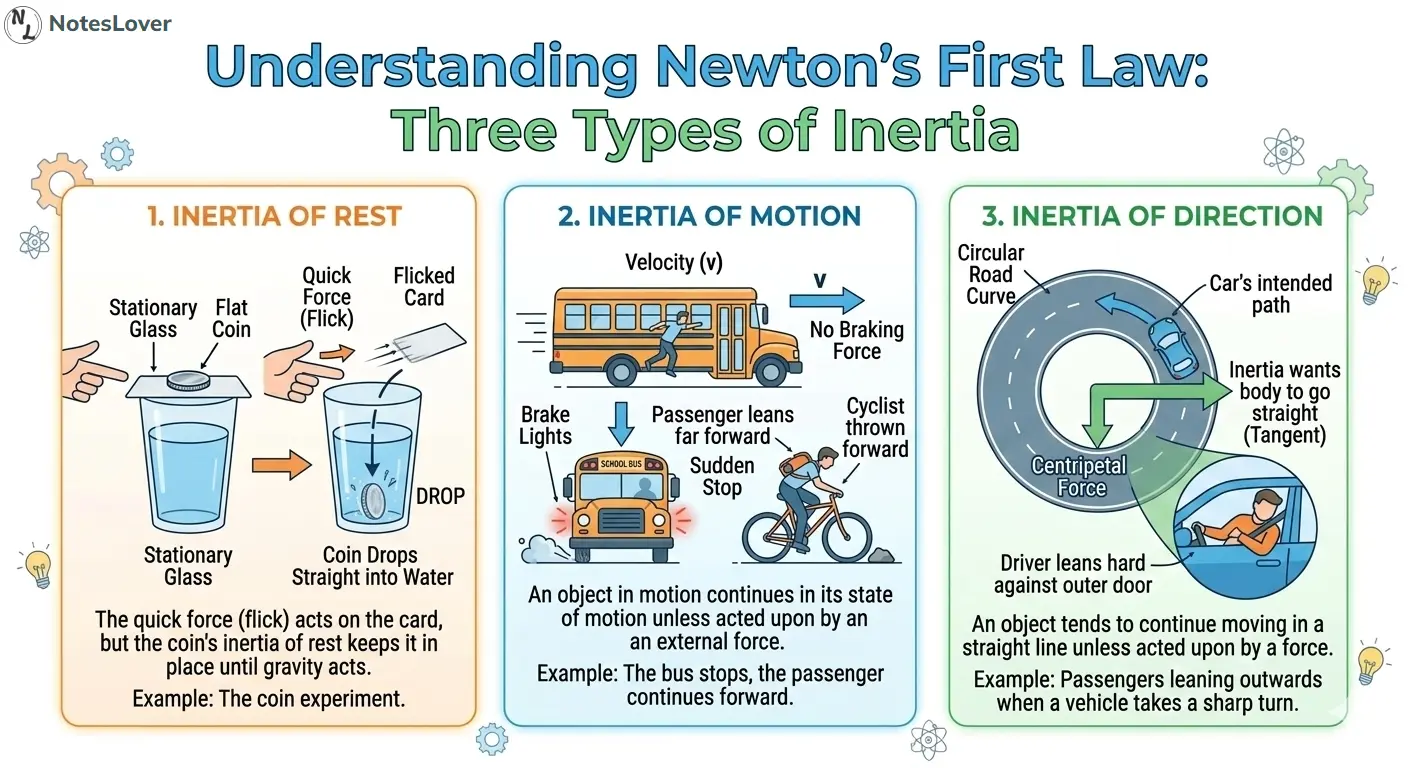
To fully grasp this law, we need to break it down into three essential components: Rest, Motion, and Direction.
1. Inertia of Rest
An object at rest stays at rest. This means if you place a book on a table, it will stay there for a hundred years unless someone moves it or an earthquake shakes the table. The object lacks the ability to move by itself.
2. Inertia of Motion
An object in motion stays in motion with the same speed. This is harder to see on Earth because of friction and air resistance. However, in deep space, if you throw a ball, it will glide forever in a straight line because there is no air to slow it down.
3. Inertia of Direction
An object will not change its direction of motion unless a force pulls or pushes it. This is why you feel pushed to the side when a car takes a sharp turn; your body wants to keep going straight, but the car is changing direction.
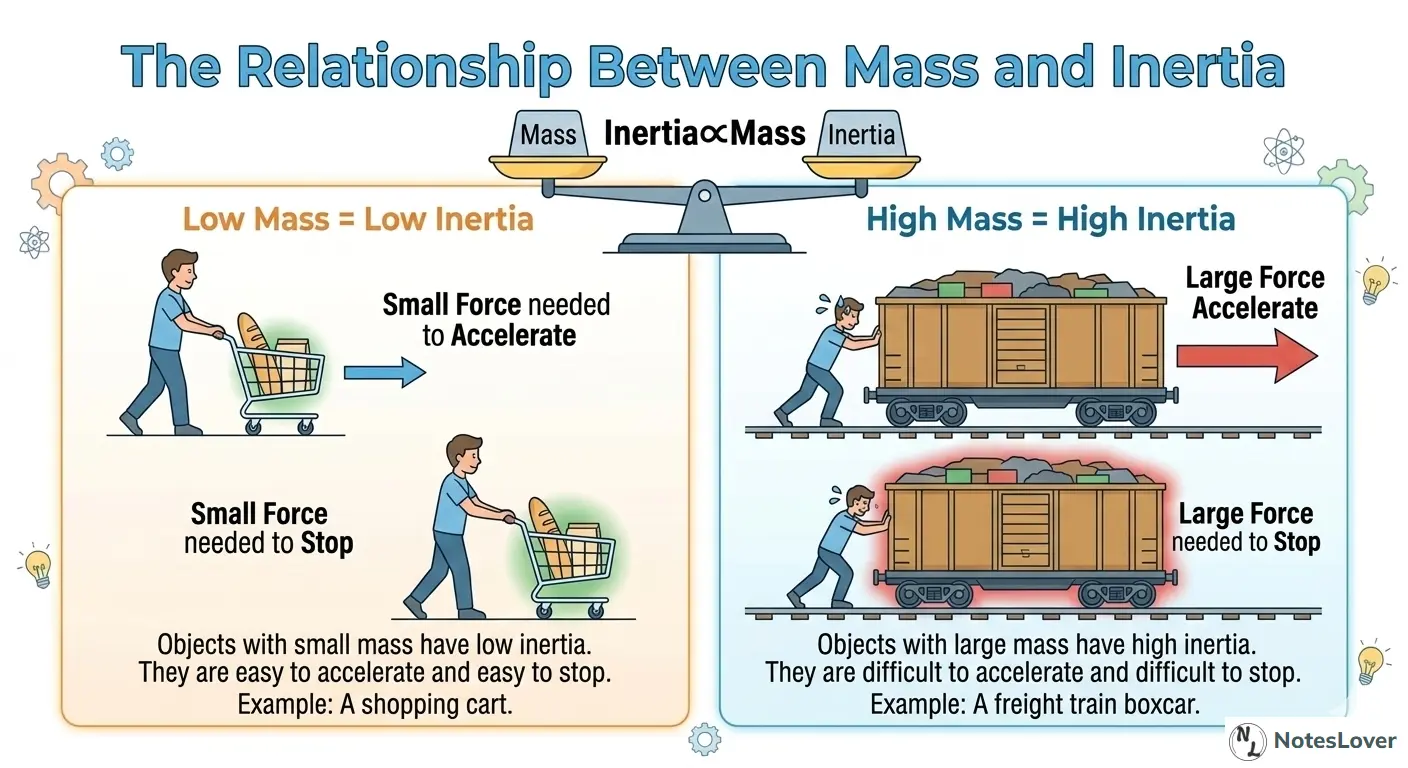
- Mass and Inertia: The amount of inertia an object has depends on its mass. A heavy truck has more inertia than a bicycle.
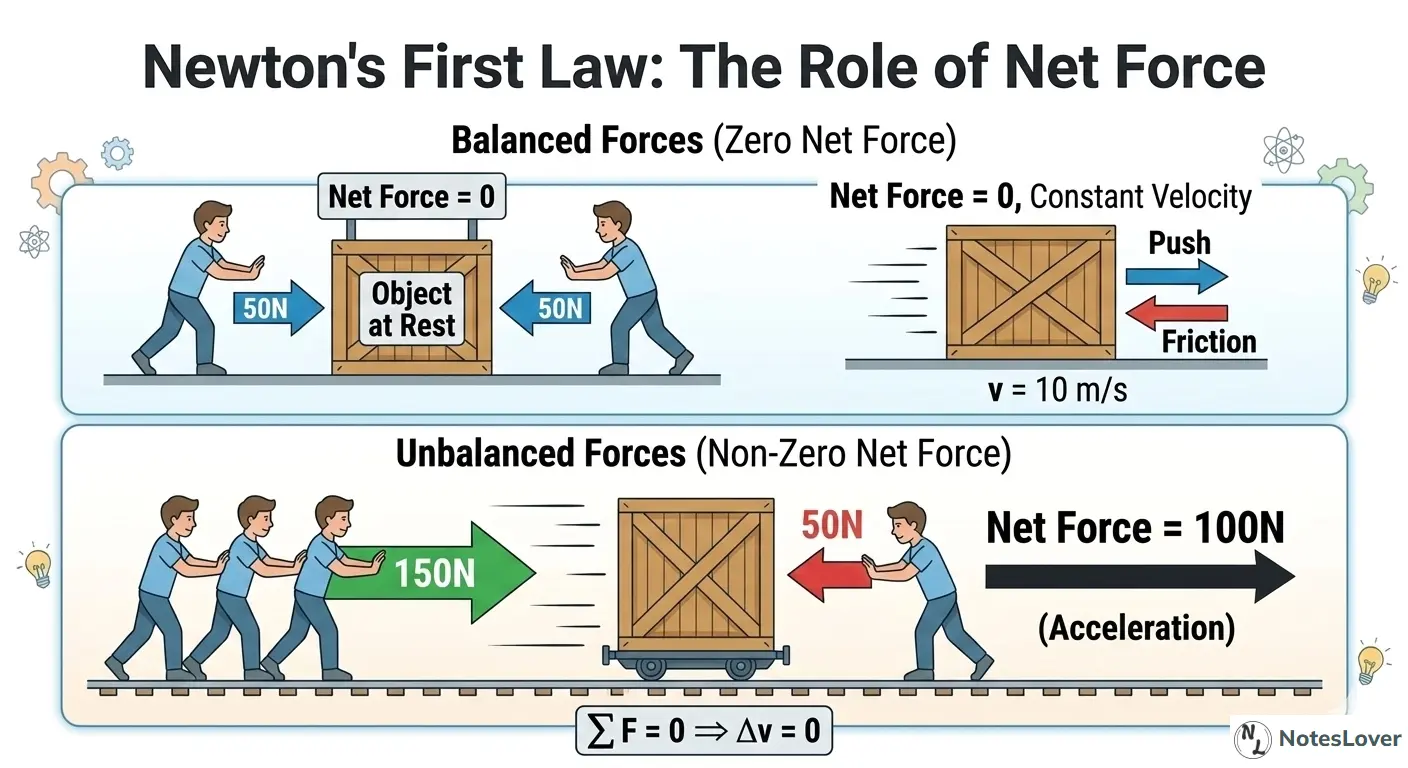
- Net Force: The law specifically refers to the "net" or unbalanced force. If two people push a box from opposite sides with equal strength, the net force is zero, and the box won't move.
- Equilibrium: When the net force is zero, the object is said to be in a state of equilibrium.
Uses and Applications
Newton's First Law isn't just a sentence in a textbook; it is used by engineers and scientists every day to design safe and efficient technology.
Safety Engineering: Car manufacturers use the law of inertia to design seatbelts and airbags. Since your body wants to keep moving forward during a crash (Inertia of Motion), the seatbelt provides the "external force" required to stop you safely.
Space Exploration: Since there is no friction in space, satellites and probes use Newton's First Law to travel vast distances. Once they reach a certain speed, they can turn off their engines and continue coasting toward their destination without wasting fuel.
Sports Science: Athletes use inertia to their advantage. A shot-putter spins to build momentum, and a goalkeeper must apply a significant force to stop a fast-moving soccer ball.
Advantages of Understanding Inertia
Understanding this law helps us predict how objects will react in different environments. Here is a summary of the benefits of applying this knowledge:
| Feature | Advantage/Explanation |
|---|---|
| Predictability | Allows us to calculate exactly how much force is needed to move or stop an object. |
| Safety Design | Helps in creating protective gear like helmets and car crumple zones. |
| Energy Efficiency | In systems with low friction, we can maintain motion without continuous energy input. |
| Astronomy | Explains the orbits of planets and the movement of celestial bodies. |
Real-Life Examples of Newton’s First Law
Let's look at some common scenarios that demonstrate the Law of Inertia in action:
The Sudden Start of a Bus
When you are standing in a stationary bus and it suddenly moves forward, you fall backward. Why? Your feet move forward with the bus floor, but your upper body wants to stay at rest due to inertia. This results in a backward jerk.
The Dusting of a Rug
When you beat a dusty rug with a stick, the rug moves forward suddenly, but the dust particles stay in their position due to inertia of rest. As a result, the dust falls out of the rug.
The Flicking of a Cardboard
If you place a coin on a piece of cardboard over a glass and flick the cardboard away quickly, the coin falls straight into the glass. The coin stays at rest because the force was only applied to the cardboard.
Comparison: Mass vs. Inertia
Students often confuse mass with inertia. While they are related, they are not the same thing.
| Property | Mass | Inertia |
|---|---|---|
| Definition | The quantity of matter in an object. | The tendency of an object to resist change. |
| Measurement | Measured in kilograms (kg). | It is a qualitative property (no specific unit). |
| Dependency | Does not change based on location. | Directly proportional to the mass. |
Frequently Asked Questions
What is the "Law of Inertia"?
The Law of Inertia is simply another name for Newton's First Law. It describes the tendency of objects to resist any change in their state of rest or uniform motion.
Does Newton's First Law apply in a vacuum?
Yes, it applies perfectly in a vacuum. In fact, it is easier to observe in a vacuum (like outer space) because there is no air resistance or friction to interfere with the object's motion.
Why do moving objects eventually stop on Earth?
On Earth, we almost always have hidden forces like friction and air resistance acting on objects. If you slide a book on the floor, friction is the "external force" that slows it down and eventually stops it.
What is the relationship between mass and the first law?
Mass is the measure of inertia. The more mass an object has, the more it will resist changes in its motion. This is why it is harder to push a car than a toy wagon.
Conclusion
Newton’s First Law of Motion is a cornerstone of physics that explains the "stubbornness" of matter. By understanding that objects will continue their current state unless forced otherwise, we can design everything from safer cars to advanced spacecraft. Remember, inertia is all about the resistance to change!
For more detailed physics notes, check out our articles on Newton's Second Law of Motion and Newton's Third Law of Motion here on Noteslover.
Recent Blogs
- Top 200 One Word Substitution (OWS) for SSC CGL, CHSL, CPO, MTS & Other Exams
- Top 200 Antonyms for SSC CGL, CHSL, CPO, MTS & Other Competitive Exams
- Top 200 Synonyms for SSC CGL, CHSL, CPO, MTS & Other Competitive Exams
- Top 200 Idioms for SSC CGL, SSC CHSL, SSC CPO, MTS, and Others with Meanings, Examples & PYQ Practice
- English Grammar Basics: Learn Rules & Sentence Structure
Recent Previous Year Papers
Recent Success Story
- SSC CGL Success Story: Rahul Parik AIR 13 - Complete Journey
- सिद्धार्थ गुप्ता UPPCS सक्सेस स्टोरी – संघर्ष, रणनीति और सफलता की पूरी कहानी
- Shubham Agrawal - SSC CGL Topper Success Story
- UPSC 2025 Top 3 Toppers - Strategy, Preparation & Study Guide
- Shakti Dubey - UPSC CSE 2024 Topper: Journey, Strategies, and Success Secrets

NotesLover
Learn. Download. Grow.
NotesLover HQ, Moradabad, Uttar Pradesh 244001, India
Quick Links
Top Categories
Subscribe
© 2026 Notes Lover. All rights reserved.