Class 10 Chemistry Chapter 2 Acids Bases and Salts Handwritten Notes PDF
Download free, high-yield Class 10 Chemistry Chapter 2 Acids, Bases and Salts Handwritten Notes PDF. This highly scannable quick-revision guide features clear property comparisons, pH scale charts, precise chemical equations for neutralization, a breakdown of important industrial salts, and the step-by-step chemistry of Plaster of Paris and water crystallization. Ideal for CBSE, ICSE, NEET/JEE foundation, and competitive exam preparation!
Overview
Mastering the foundational principles of chemical solutions is essential for secondary education boards and competitive streams. This comprehensive set of Class 10 Chemistry Chapter 2: Acids, Bases and Salts Handwritten Notes translates complex reactions into highly digestible visual blocks, scannable summary tables, and straightforward chemical equations.
Curated strictly according to the latest curriculum benchmarks for CBSE, ICSE, and early foundation tracks like NEET and JEE, this free PDF document ensures zero fluff and maximum retention.
Key Topics Covered in This Notes Package:
-
Fundamentals of Acids & Bases: Core definitions, structural differences (sour vs. bitter/soapy), and distinctive properties. Includes a quick lookup of common indicators like litmus.
-
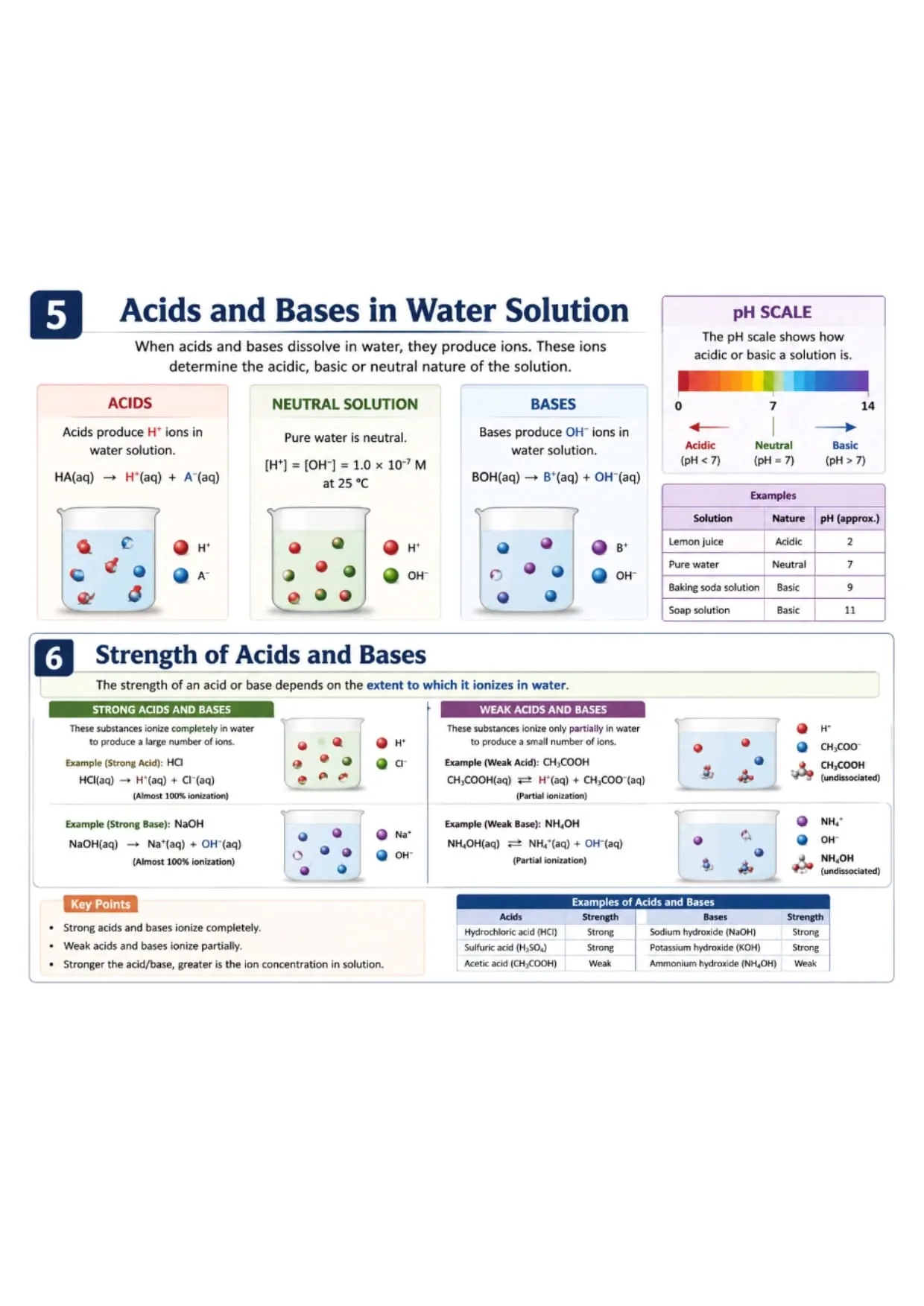
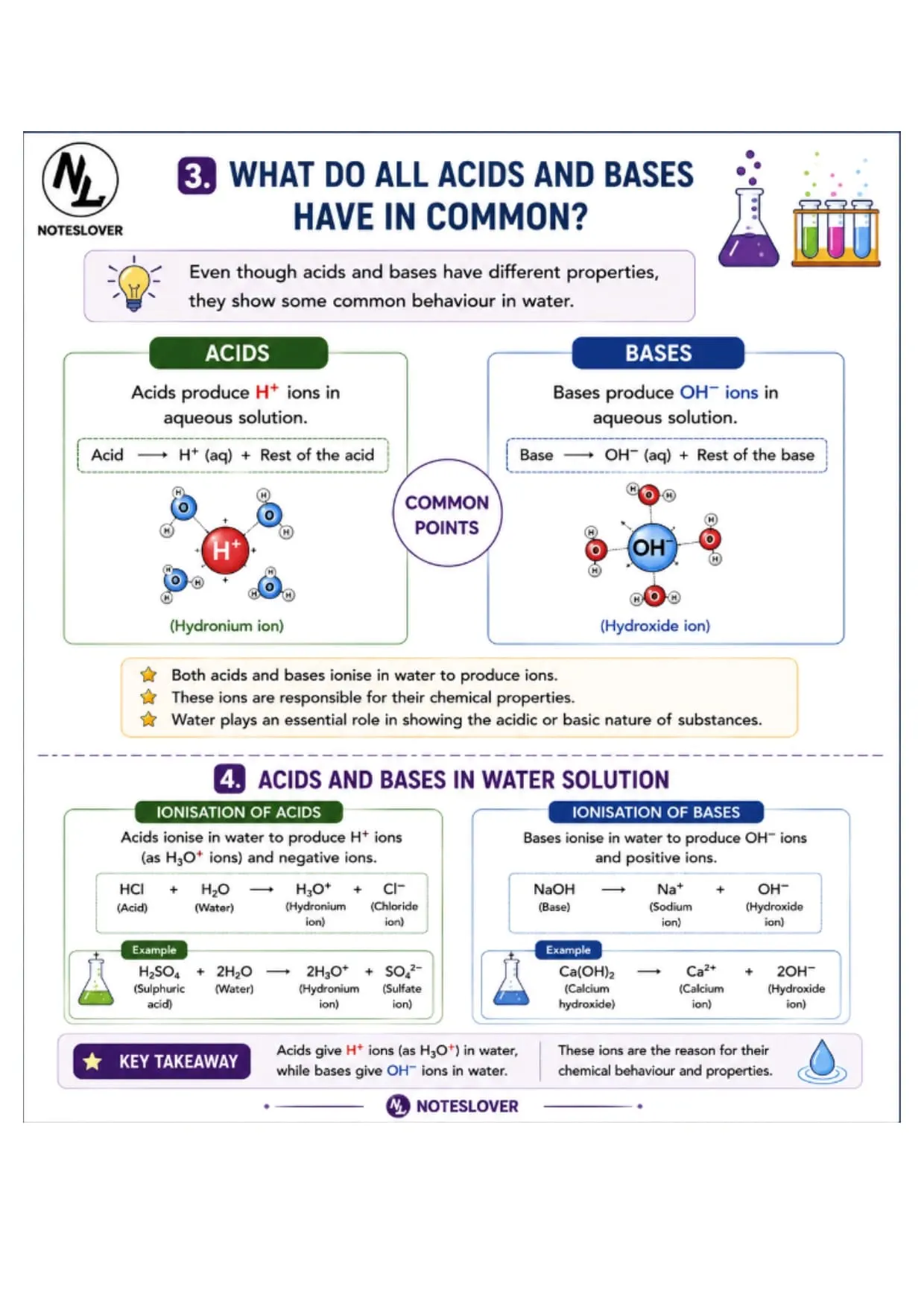
Ionisation & The Water Solution Dynamics: Deep-dive into how acids yield hydronium ions ($H_3O^+$ or $H^+$) and bases yield hydroxide ions ($OH^-$) in aqueous environments.
-
The pH Scale Masterclass: A definitive breakdown of the logarithmic pH scale running from 0 to 14. Includes an approximate pH reference chart for everyday items (from strongly acidic battery acid to strongly basic household bleach) and underscores its vital role in digestion, soil agriculture, and aquatic life safety.
-
Acid-Base Strengths: Highlighting the behavioral difference between complete ionisation (Strong Acids/Bases like $HCl$ and $NaOH$) and partial ionisation (Weak Acids/Bases like $CH_3COOH$ and $NH_4OH$).
-
Neutralisation Reactions: Detailed look at the exothermic general equation ($Acid + Base \rightarrow Salt + Water$) complete with standard ionic views, color shifts using indicators like phenolphthalein, and its structural application in everyday life (antacids, tooth care, and wastewater management).
-
The Chemistry of Salts: Comprehensive classification into Normal, Acid, Basic, and Double salts (such as Mohr's salt). Features production mechanics and commercial use cases for essential compounds:
-
Sodium Chloride ($NaCl$)
-
Sodium Hydrogen Carbonate ($NaHCO_3$)
-
Sodium Carbonate ($Na_2CO_3$)
-
Calcium Sulfate ($CaSO_4$)
-
Ammonium Chloride ($NH_4Cl$)
-
Potassium Nitrate ($KNO_3$)
-
-
Plaster of Paris (POP): A focused section detailing the precise formulation of Calcium Sulfate Hemihydrate ($CaSO_4 \cdot \frac{1}{2}H_2O$) via controlled gypsum heating at $373\text{ K} / 100^\circ\text{C}$, its hydration-based hardening pathways, and safety precautions.
-
Water Crystallization Mechanisms: Exploring how pure solid crystal particles separate from saturated solutions through slow cooling or evaporation, complete with industrial significance in purification and metallurgy.
Core Features of These Notes:
-
Exam-Ready Architecture: Key indicators, definitions, and equations are strategically boxed and bolded for rapid review nights before the test.
-
Highly Graphical Flow: Uses clean step-by-step process breakdowns (e.g., the 4-step crystallization framework) instead of overwhelming textbook paragraphs.
-
Competitive Foundation: Built around core solubility rules and exact stoichiometric balances to anchor high scores across school finals and competitive testing environments.
Tags
Preview ( 4 Pages)
View All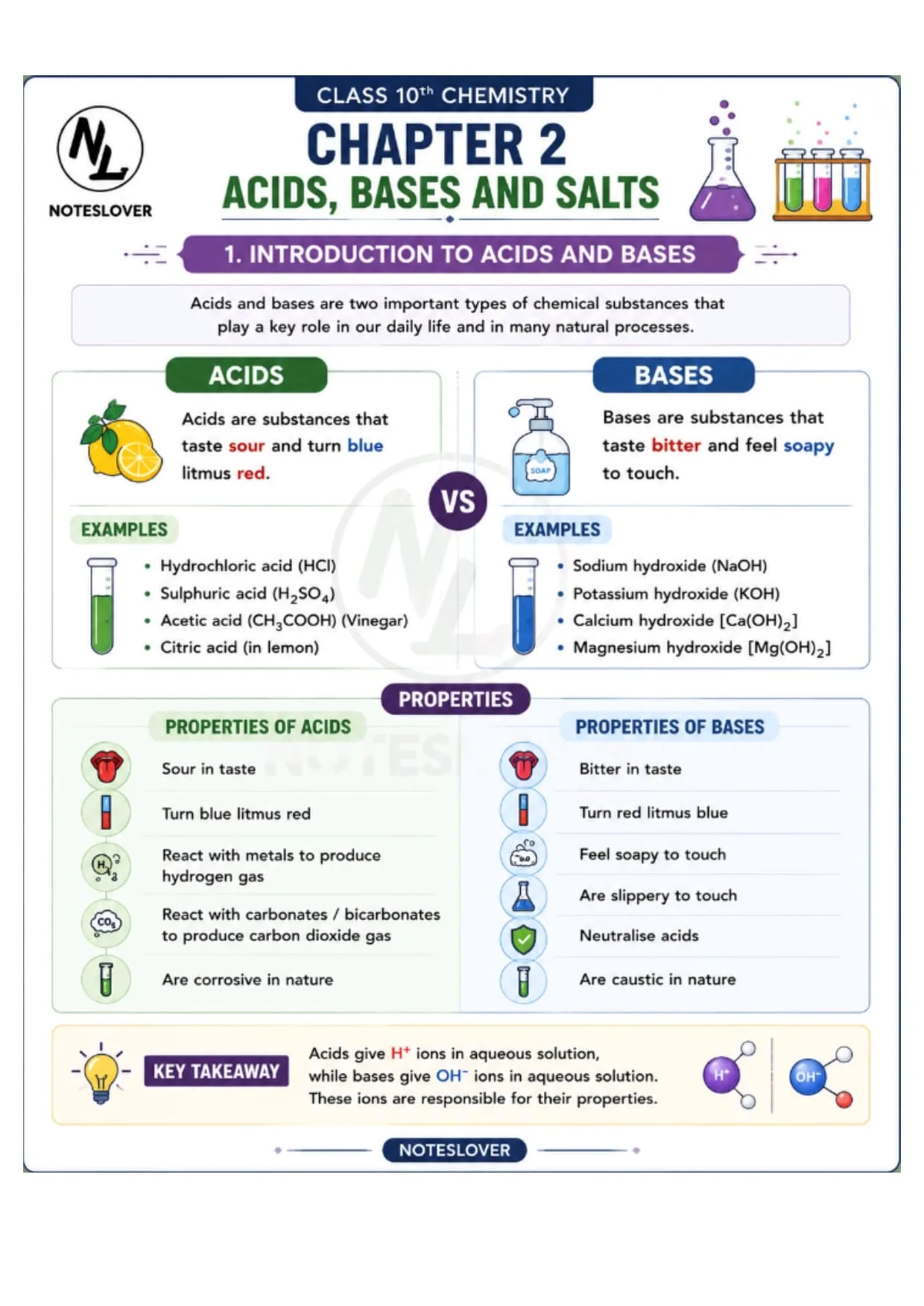

NotesLover
Learn. Download. Grow.
NotesLover HQ, Moradabad, Uttar Pradesh 244001, India
Quick Links
Top Categories
Subscribe
© 2026 Notes Lover. All rights reserved.