Last Updated: Oct 08, 2026
Uploaded By: NotesLover
3,133 Views
handwritten notes study notes exam preparation effective notes note making tips toppers notes revision techniques student productivity exam strategy study hacks note taking methods how to make notes competitive exam notes board exam notes le
How to Make Effective Handwritten Notes for Any Exam (Step-by-Step Guide)
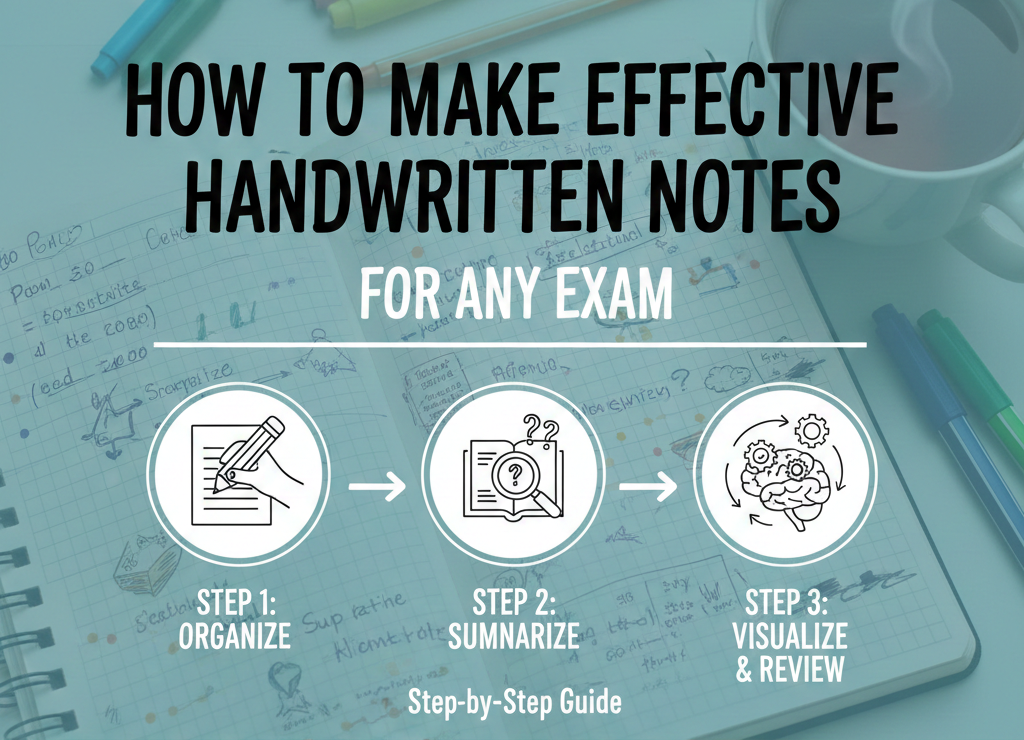
Preparing for competitive exams or school/college tests becomes 10x easier when you have powerful handwritten notes. Good notes save time, improve memory, boost revision speed, and help you stay organised during exam pressure.
In this guide, we'll show you step-by-step how to make effective handwritten notes for ANY exam - UPSC, SSC, NEET, JEE, Boards, CUET, State Exams, or College Semester Exams.
Why Handwritten Notes Are Important for Students
Handwritten notes help you:
-
Understand concepts better
-
Remember faster (writing improves retention)
-
Revise quicker before exams
-
Keep information clear and organised
-
Stay focused without distraction
-
Build your own personalised study material
A topper's secret weapon = clean, crisp, exam-oriented handwritten notes.
Step-by-Step Guide to Creating Effective Handwritten Notes
Step 1: First Understand the Syllabus & Weightage
Before writing anything, know:
-
What topics are important
-
What chapters carry more marks
-
What type of questions are asked
-
What topics are repeated every year
Don’t write notes on everything - write notes only on important topics.
Step 2: Do a Quick Reading First (Don't Start Writing Immediately)
Many students directly start writing notes → waste of time.
Instead:
-
Read the chapter once
-
Underline important points
-
Mark confusing areas
-
Identify exam-relevant content
Then start notes.
Step 3: Use the Right Notebook & Format
A perfect notes notebook should be:
-
A4 size (good spacing)
-
Single side writing (clean revisions)
-
Enough margins
-
Clear spacing
Format to follow:
-
Topic heading
-
Subheadings
-
Bullet points
-
Flowcharts
-
Examples
-
Formulas
This structure makes notes visually easy and faster to revise.
Step 4: Write in Your Own Words
Don’t copy the textbook line-by-line.
Writing in your own language forces your brain to process and understand the topic.
Your notes should be:
✔ Simple
✔ Easy to understand
✔ Point-wise
✔ Your own language
Step 5: Use Visuals - Diagrams, Charts, & Flowcharts
Visual notes boost memory.
Use:
-
Flowcharts
-
Mind maps
-
Diagrams
-
Tables
-
Graphs
-
Comparison charts
These help you revise 5 pages in 30 seconds.
Step 6: Highlight Important Lines (Smart Highlighting)
Don’t highlight the whole page.
Highlight only:
-
Key formulas
-
Definitions
-
Examples
-
Dates & years
-
Important facts
-
Keywords
Use 2-3 colours max (too many colours = distraction).
Step 7: Make Notes Exam-Focused
Always keep your goal in mind → Marks
So write:
-
Previous year repeated points
-
Shortcuts
-
Tricks
-
Expected questions
-
Summary boxes
Create a “Quick Revision Section” at the end of each chapter.
Step 8: Keep Notes Short & Crisp
If your notes are too long → they will feel like textbooks.
Golden rule:
➡ 150-page chapter should become 10-12 pages of notes.
Cut out:
-
Long stories
-
Extra theory
-
Useless examples
-
Difficult vocabulary
Stick only to exam-oriented content.
Step 9: Revise Your Notes Regularly
Handwritten notes are useful only if you revise them.
Follow:
-
Daily: 10–15 min revision
-
Weekly: re-read all notes
-
Before exam: 2–3 full revisions
Notes should be your first AND last revision book.
Step 10: Update Notes Whenever Needed
When you find:
-
New formula
-
Better explanation
-
Important question
-
Teacher’s hint
-
PYQ pattern
-
Correction
→ Add it to your notes.
Notes keep improving with time.
Bonus Tips to Make Your Notes Topper-Level
✔ Use Mnemonics (Memory Tricks)
Example:
Biology lists, History dates, Physics laws.
✔ Keep Each Topic on a New Page
It looks clean and organised.
✔ Leave Space Between Lines
Easier to edit later.
✔ Use Abbreviations & Symbols
Improve speed while writing.
✔ Add Question Bank at the End
Expected questions + PYQs = best revision.
Common Mistakes Students Make (Avoid These!)
❌ Writing too much
❌ Copying books line-by-line
❌ Using too many colours
❌ Not updating notes
❌ Not following the syllabus
❌ Poor handwriting
❌ No headings/subheadings
❌ Notes that are longer than the chapter
Fix these, and your notes become 5× more effective.
Final Summary
Effective handwritten notes should be:
-
Short
-
Clear
-
Visual
-
Exam-oriented
-
Organised
-
Easy to revise
If you follow this step-by-step guide, your revision efficiency will go up by 40–60%, and exam performance will improve automatically.
???? Want Ready-Made Notes for Exam Prep?
You can download high-quality handwritten notes for multiple exams from NotesLover.com.
We upload:
-
Handwritten notes
-
Toppers' notes
-
Subject-wise notes
-
Chapter-wise PDFs
-
PYQs + Solutions
All 100% clean and exam-focused.
Recent Blogs
- Top 200 One Word Substitution (OWS) for SSC CGL, CHSL, CPO, MTS & Other Exams
- Top 200 Antonyms for SSC CGL, CHSL, CPO, MTS & Other Competitive Exams
- Top 200 Synonyms for SSC CGL, CHSL, CPO, MTS & Other Competitive Exams
- Top 200 Idioms for SSC CGL, SSC CHSL, SSC CPO, MTS, and Others with Meanings, Examples & PYQ Practice
- English Grammar Basics: Learn Rules & Sentence Structure
Recent Previous Year Papers
Recent Success Story
- SSC CGL Success Story: Rahul Parik AIR 13 - Complete Journey
- सिद्धार्थ गुप्ता UPPCS सक्सेस स्टोरी – संघर्ष, रणनीति और सफलता की पूरी कहानी
- Shubham Agrawal - SSC CGL Topper Success Story
- UPSC 2025 Top 3 Toppers - Strategy, Preparation & Study Guide
- Shakti Dubey - UPSC CSE 2024 Topper: Journey, Strategies, and Success Secrets

NotesLover
Learn. Download. Grow.
NotesLover HQ, Moradabad, Uttar Pradesh 244001, India
Quick Links
Top Categories
Subscribe
© 2026 Notes Lover. All rights reserved.