Last Updated: Sep 22, 2026
Uploaded By: NotesLover
734 Views
study tips student habits focus improvement productivity hacks mobile addiction digital wellbeing exam preparation concentration techniques time management smart study student lifestyle distraction control practical study guide dopamine contr
How to Avoid Mobile Addiction During Studies - Practical Plan for Students
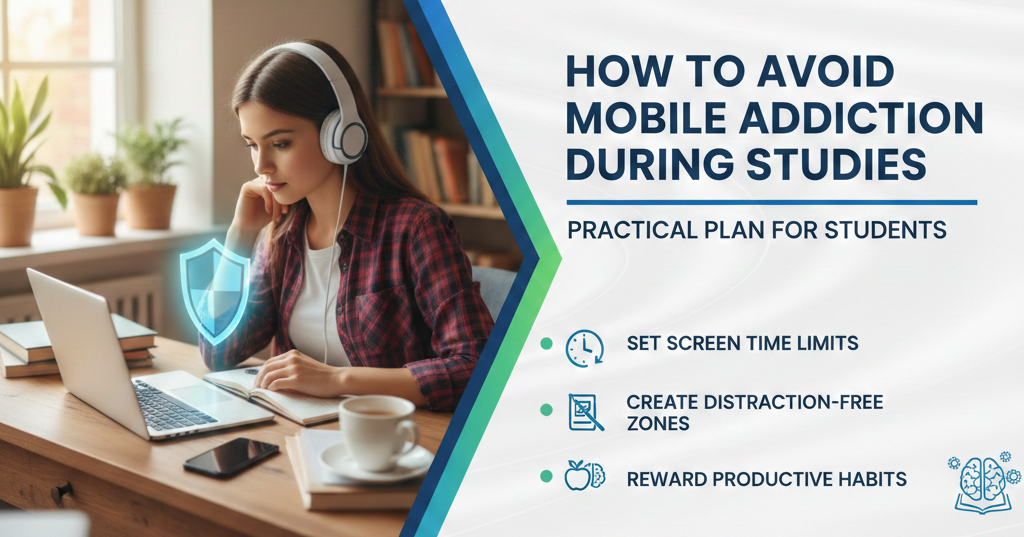
Mobile addiction is one of the biggest reasons students fail to focus on studies. Notifications, reels, YouTube shorts, gaming, and endless scrolling activate the brain’s dopamine system - making it extremely difficult to stop once you start.
But the good news is:
You don't need to throw away your phone. You just need a scientifically designed plan to control it.
In this guide, you’ll learn a realistic, practical, science-backed plan to avoid mobile addiction and study with full focus.
Let’s begin.
Why Mobile Feels So Addictive (Science in Simple Words)
Social media, reels, games - all release dopamine, the feel-good chemical.
Dopamine:
-
Makes your brain crave more scrolling
-
Distracts your decision-making power
-
Reduces focus
-
Shortens attention span
Your brain gets “rewarded” faster by mobile than books, so it naturally chooses the phone again and again.
The goal is not to “remove dopamine” - the goal is to control when and how you get it.
1. The Biggest Mistake Students Make
Most students try to avoid their phone using willpower.
But science says:
Willpower lasts only 10-15 minutes under temptation.
So the solution is NOT “trying harder,”
but changing your environment, timings, and habits.
2. Practical, Proven Plan to Avoid Mobile Addiction
Here is a step-by-step plan you can actually follow.
Step 1: Make Your Phone Physically Hard to Reach
The farther your phone is, the better your focus.
Try:
-
Keep phone in another room during study
-
Put it out of sight, not on the table
-
Keep it inside a drawer or cupboard
Studies show that even a silent phone on the table reduces focus by 20%.
Step 2: Use the 20-Second Delay Rule
Every time you want to check your phone, make it inconvenient.
For example:
-
Put your phone in a zipper bag
-
Keep it switched off
-
Use a lock box
-
Turn on flight mode
When checking your phone takes 20 seconds of effort, the brain loses interest.
Step 3: Use Apps That Block Distraction
Instead of the phone controlling you, let your phone help you study.
Best apps:
-
Forest
-
Stay Focused
-
AppBlock
-
Digital Wellbeing (built-in)
-
Cold Turkey
Block:
-
Instagram
-
Shorts
-
Snapchat
-
Games
-
YouTube homepage
You can allow only educational content or PDFs.
Step 4: Use a Dumb Phone During Study Hours
This is extremely effective.
Have a small keypad phone for:
-
Calls
-
Messages
-
Emergencies
Switch off your smartphone during study time.
Toppers preparing for NEET, JEE, UPSC actually do this.
Step 5: Study Using Timed Sessions (Pomodoro)
Set a timer:
-
40 minutes deep study
-
10 minutes break
During the break, you can check your phone - but only for 2-3 minutes.
This method builds control without forcing yourself too much.
Step 6: Keep a Distraction Log
Whenever you feel:
-
“Let me just check WhatsApp”
-
“One reel only…”
-
“Just one game…”
Write it down in a notebook.
This makes your brain more aware and reduces impulsive behaviour.
Step 7: Charge Your Phone Far Away from Bed
Never study with a phone on the bed or table.
When you charge your phone:
-
In the hall
-
In the kitchen
-
Away from your room
…your mind stops thinking about it repeatedly.
Step 8: Use the Phone Only at Fixed Timings
Set strict usage windows:
-
Morning: 20 minutes
-
Afternoon: 20 minutes
-
Night: 30 minutes
That's it.
You can follow the 20-20-30 rule.
Your brain then adjusts and stops craving constant mobile use.
Step 9: Don't Use Your Phone Early in the Morning
The first 1-2 hours after waking up decide your entire day’s focus.
If you start your day with:
-
Reels
-
WhatsApp
-
Notifications
-
Messages
Your dopamine skyrockets → making studying harder.
Morning = no mobile zone.
Step 10: Replace Mobile with Better Alternatives
Most students use mobile for:
-
Entertainment
-
Stress relief
-
Timepass
Replace them with:
-
Music
-
Outdoor walk
-
Talking to family
-
Drinking tea
-
Reading a book
Your brain will adapt to healthier habits.
Bonus: Remove Trigger Points
Triggers = things that force you to pick your phone.
Examples:
-
Notifications
-
Bright wallpapers
-
New message numbers
-
Seeing the phone near you
Fix them:
-
Turn off all notifications
-
Use black wallpaper
-
Remove social media apps
This reduces 60% of random checking.
Daily Anti-Mobile Addiction Routine (Proven & Easy)
Morning
-
Don’t touch phone for 1 hour
-
Study in airplane mode
-
Keep phone outside the room
Afternoon
-
Use phone only for 20 minutes
-
Block non-study apps
Evening
-
Use phone only after finishing tasks
-
Keep the phone away while revising
Night
-
Avoid screens 1 hour before sleep
-
Use alarm clock instead of mobile
-
Keep phone outside the bedroom
Follow this routine for 21 days, and your control over mobile will increase drastically.
What Toppers Do to Control Phone Use
Toppers preparing for competitive exams follow these habits:
-
They use phone only for “productive things”
-
They treat mobile like a “tool,” not entertainment
-
They study with books, not screens
-
They remove all distracting apps
-
They use timers for study sessions
-
They keep phone far away during study
If toppers can do it, you can too.
Quick Hacks to Break Mobile Addiction
-
Turn screen to black & white mode
-
Delete social apps permanently
-
Use separate phone for studying
-
Keep phone in cupboard & lock it
-
Ask family to take your phone during study hours
-
Use analog clock instead of phone clock
Final Words
Mobile addiction is not your fault - it's how the apps are designed.
But with a proper plan, discipline, and the right strategy, you can easily regain control and dramatically improve your focus and grades.
Start with small steps.
Follow the 21-day routine.
Watch your concentration power grow like magic.
Recent Blogs
- Top 200 One Word Substitution (OWS) for SSC CGL, CHSL, CPO, MTS & Other Exams
- Top 200 Antonyms for SSC CGL, CHSL, CPO, MTS & Other Competitive Exams
- Top 200 Synonyms for SSC CGL, CHSL, CPO, MTS & Other Competitive Exams
- Top 200 Idioms for SSC CGL, SSC CHSL, SSC CPO, MTS, and Others with Meanings, Examples & PYQ Practice
- English Grammar Basics: Learn Rules & Sentence Structure
Recent Previous Year Papers
Recent Success Story
- SSC CGL Success Story: Rahul Parik AIR 13 - Complete Journey
- सिद्धार्थ गुप्ता UPPCS सक्सेस स्टोरी – संघर्ष, रणनीति और सफलता की पूरी कहानी
- Shubham Agrawal - SSC CGL Topper Success Story
- UPSC 2025 Top 3 Toppers - Strategy, Preparation & Study Guide
- Shakti Dubey - UPSC CSE 2024 Topper: Journey, Strategies, and Success Secrets

NotesLover
Learn. Download. Grow.
NotesLover HQ, Moradabad, Uttar Pradesh 244001, India
Quick Links
Top Categories
Subscribe
© 2026 Notes Lover. All rights reserved.